Powered By Blogger
Mostrando las entradas con la etiqueta O'Connor‚ Joseph. Mostrar todas las entradas

lunes, 31 de agosto de 2009

When a man to mitigate his punishment claims that his actions were 'natural'...


[The Captain of the Star of the Sea, a vessel, writes:]


Tonight I had necessity to punish one of the men, Joseph Cartigan of Liverpool, who had been importuning some of the women in steerage and making shameful suggestions by which he meant to gain advantage from their present unhappy state. Apparently he had been offering food in return. I do not like at all to punish the men, but they know I will not have decent girls ruined on my ship. Summoning him to my quarters, I asked if he had a mother; anod how would he care for her to be translated to a whore? He said she was one already, the busiest in Liverpool. (I swear his ears quite wriggle with insolence.)

Chaucer asserts, in his Prologue of the Reeve: ‘Til we be roten kan we not be rype.’ If that be the case, then this Mersey-mud placket-hound is so ripe as to be practically intoxicating.

His appeal was that he had attemted nothing save what was natural, given the length of the voyage & cetera. At that I ordered the wretch’s rations halved for three days, the moiety to be given to some poor girl in steerage. I have oftentimes observed the veracity of the late Admrl. Wm. Bligh’s remark (first captain under whom I myself served as a boy, on the charting and fathoming of Dublin Bay) that when a man claims in mitigation that his actions be ‘natural’ he is invariably behaving much worse than a beast, without exception to one much weaker than himself.


Joseph O’Connor
Star of the Sea
Harvest, 2004
Pages 153-4

miércoles, 19 de agosto de 2009

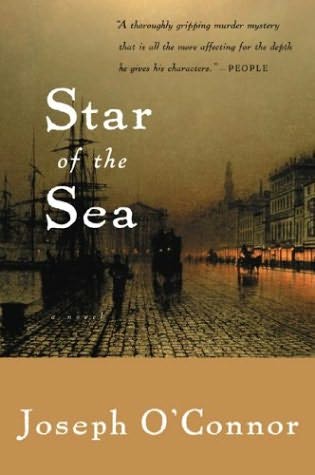
Star of the Sea; Joseph O'Connor


Fiction.

1847. A vessel, the Star of the Sea, departs from an Ireland stormed by the famine. Most of the passengers of the ship are poor farmers and land tenants driven away from their properties. Among them travel Lord Meredith (a nobleman in bankruptcy), his wife, their two children, their maid, a journalist and a man who carries in his past a long list of murders, this last fact unknown to the other passengers, or so it seems…

The destination of the Star of the Sea is America, the Promised Land for most of the passengers. However, each of them, not only the killer, carries a hidden past: one that the author of this novel is going to reveal to us as we read the chapters that describe the 29 days of the voyage.

The double sense in the name and description of each chapter is a resource that the author used in a very original way. The story is intriguing since the beginning. The depth given to the backgroung and motivations of each character are one of the most interesting aspects of this novel.

The atmosphere of the novel is polluted by the famine and corruption of the land which even follows the passengers in their travel on the sea. But the rottenness is also present in some of their own flesh and hearts.

Besides all of this, reading Star of the Sea could propose to us the following question:

Is the act of writing history a creative one?

I think it could be. After all, history and fiction share no few aspects.